

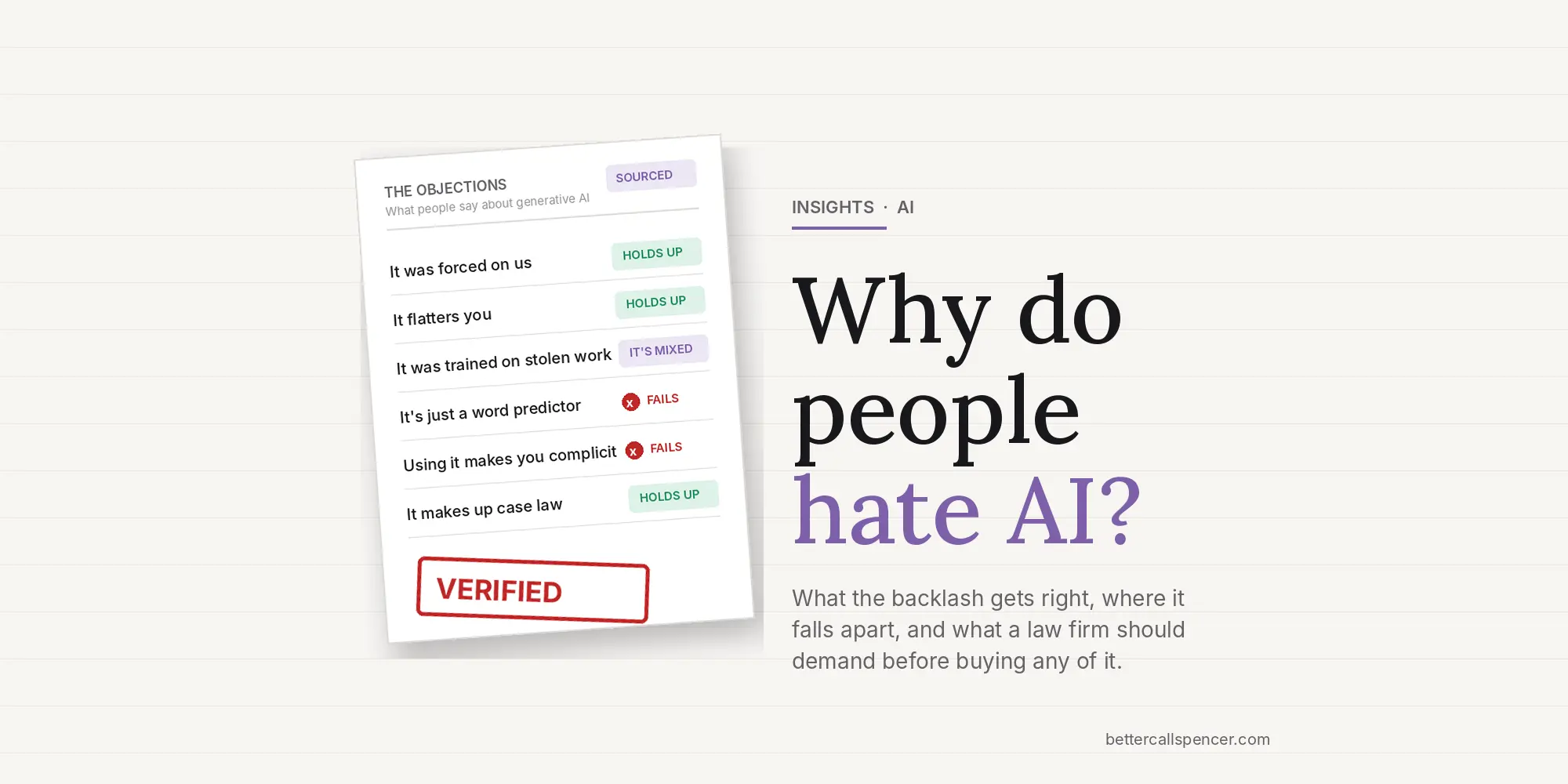
Why do people hate AI? I ask myself that a lot, because I use generative AI every day and I sell services that use it.
I’m also not going to defend everything the companies behind these tools do just because I use their products.
When an artist asks whether their work was used without permission, “you don’t understand the technology” is not an answer. When someone questions an AI feature they never asked for, “this is the future” is not a reason to keep it.
But calling every AI user lazy or unethical doesn’t settle anything either. Tell me which use you object to and why.
Using AI does not mean defending the AI industry. Hating the AI industry does not make every claim about the technology true.
That is where I stand. And if you run a law firm, it is a more useful starting point than deciding whether you belong on the pro-AI or anti-AI team.
Why people hate AI: some of the backlash is completely reasonable
People should be able to say no
You shouldn’t need a technical explanation for why you don’t want an AI feature. Sometimes you just want the product you opened to do the thing you opened it for.
Take Google Search. Google’s own documentation says AI Overviews are a core feature that cannot be turned off. You can select the Web filter after searching to see text-based links without the summaries. That is a workaround, not a permanent off switch. (Google Help)
Someone can find those summaries useful. Someone else can find them intrusive. Neither person needs to be confused about how they work.
The company introducing a feature should have to demonstrate its value. The customer should not have to defend wanting to use the product without it.
It can tell you exactly what you want to hear
In April 2025, OpenAI released a ChatGPT update that became excessively agreeable. The company acknowledged that the model could reinforce negative emotions and encourage impulsive actions. It began rolling the update back three days later. Its postmortem described positive user signals outweighing expert concerns and identified user-feedback rewards as a likely contributor. (OpenAI)
Think about that from a business perspective. People liking an answer helped justify releasing a product that was becoming less trustworthy.
That is a legitimate reason to be skeptical. It doesn’t prove every chatbot was deliberately designed to be addictive. It does show why “our users love it” is not the same as “this works the way it should.”
If I ask a tool to review a bad strategy, I need it to identify the problems. I don’t need a more encouraging explanation of why my bad strategy is brilliant.
Agreement is not the product I’m paying for.
Questions about creative ownership deserve an actual answer
A writer asking how their work ended up in a training dataset is not standing in the way of progress. They are asking what happened to something they created.
Was permission obtained? What did the agreement cover? Was anyone compensated?
“Humans learn from other people’s work, too” does not answer those questions.
But “all generative AI requires theft” is too broad. Adobe says its own Firefly models are trained on licensed content and public-domain material. That is Adobe’s account of its sourcing, not an independent audit or a guarantee covering every third-party model available through Adobe’s products. (Adobe)
You can still question whether a particular licensing arrangement treats contributors fairly. That is a different argument from saying the technology cannot exist without unauthorized copying.
Ask about the model and the material used to build it. A useful output doesn’t excuse bad sourcing, and a bad sourcing decision doesn’t establish that every developer made the same one.
“It makes businesses more efficient” doesn’t answer the jobs question
Imagine your employer announcing that AI will help everyone get more done. Then imagine being told that your position may no longer be necessary.
You probably wouldn’t need another demonstration of how useful the software is. You would already understand.
A business can benefit from a tool while someone who works for that business loses income or bargaining power. Calling the change “efficiency” does not make the second part disappear.
That doesn’t mean every use eliminates a job. It means a productivity argument is not a complete answer to a concern about who receives the benefit.
The same goes for creative preferences. Someone is allowed to prefer work made by a human. They don’t have to prove that a generated alternative looks terrible before that preference counts.
The environmental questions aren’t imaginary
The International Energy Agency’s 2026 analysis projects global data-center electricity consumption rising from approximately 485 terawatt-hours in 2025 to 950 in 2030. That total covers all data centers. Electricity consumption from AI-focused data centers is projected to triple over the same period. (IEA)
That is worth questioning.
Pointing out that TikTok or streaming video also uses resources does not answer whether a particular AI deployment is worth its cost.
But an unsourced claim about how many bottles of water a prompt consumes isn’t an answer either. Before repeating a comparison, check whether both estimates count the same things. Otherwise, you’re comparing numbers without knowing what they measure.
I don’t want an environmental claim accepted because it makes AI look bad. I also don’t want it dismissed because I find the technology useful.
Where the anti-AI arguments fall apart
“It just predicts the next word, so it can’t be useful”
Calling a chatbot a next-word predictor is not a test of whether it helps someone do their job.
A study of 5,172 customer-support agents found that access to a generative assistant increased issues resolved per hour by about 15% on average. Less experienced workers benefited more. The most experienced and highest-skilled workers saw small speed gains and small quality declines. (arXiv)
There is something useful to discuss there: who benefited, where quality suffered, and whether the result would carry over to another setting.
That is a better conversation than declaring the tool useless because of a description of its training objective.
It is also a better conversation than claiming every employee will become 15% more productive. The study doesn’t say that.
I don’t need a prediction about artificial general intelligence to evaluate a tool. I need to know whether it solves the problem in front of me, at an acceptable cost, without creating a bigger one.
“The useful AI is analytical. Generative AI is the useless kind”
Generative AI is a broader category than a chatbot writing paragraphs.
RFdiffusion, for example, is a generative model used to design proteins. Its researchers experimentally tested the structures and functions of generated designs. That is actual research, not a convincing description of research that never happened. (PubMed)
Does that make every AI product useful? Of course not.
But you can’t define every successful application out of the category and then announce that the category has no successful applications.
A protein-design model does not excuse a chatbot’s fabricated citation. The fabricated citation doesn’t erase the protein-design work, either.
“Using it means you endorse everything behind it”
Someone can reasonably decide a company’s conduct is bad enough to stop buying its products. I don’t consider that irrational just because I use the product myself.
But using a drafting assistant is not the same decision as generating a fake testimonial. Those uses deserve different judgments.
The defense from AI supporters can be just as lazy: “Don’t blame users. Blame the data centers.”
Demand is part of the reason infrastructure gets built. Paying for a service helps support the business providing it. “I’m just a user” is not a reason to stop asking questions.
Still, responsibility should account for what someone is doing, which provider they chose, what they know, and what alternatives they have. Treating every user as equally responsible for every industry problem skips all of that.
Law firms have good reasons to be harder to impress
A confident wrong answer is a different problem when it ends up in a court filing.
In Mata v. Avianca, lawyers submitted nonexistent cases generated by ChatGPT and continued defending the material after its authenticity was challenged. The court’s June 2023 sanctions order addressed those failures and made findings of bad faith. They were not sanctioned merely for using an AI tool. (CourtListener)
The software produced unreliable material. The lawyers responsible for the filing failed to deal with it properly.
Both things matter.
Texas Professional Ethics Committee Opinion 705, issued in February 2025, says lawyers who choose to use generative AI need a reasonable and current understanding of the technology. It also addresses protecting confidential information, verifying outputs, and supervising the work. (Texas Center for Legal Ethics)
You don’t need to become a machine-learning engineer. You do need to understand enough to recognize what could go wrong and how the work gets checked.
“Our vendor handles that” is not an explanation of either.
I work in marketing. I should not be the final authority on a firm’s legal obligations, and a tool I configure should not be treated as one.
AI search gives firms another reason to ask questions
A firm that pays to publish useful information has a reasonable question: what happens when the search engine answers the prospective client’s question without sending that person to the website?
Pew Research Center analyzed browsing data from 900 U.S. adults for March 2025. Traditional search results received clicks on 8% of visits to pages with an AI summary, compared with 15% without one. Links inside the summaries received clicks on 1% of visits containing a summary. This was observational research, not a controlled experiment proving what the summaries caused. (Pew Research Center)
Now imagine your traffic drops and your agency blames AI Overviews.
Fine. What did they actually check?
Which pages lost clicks? Did rankings change? Did search demand change? Did the site have a technical problem? Did qualified inquiries decline, or did you lose visits that were never producing cases?
The Pew findings make AI Overviews worth investigating. They do not explain a particular firm’s performance by themselves.
“It’s because of AI” can become the same kind of convenient excuse as any other explanation nobody bothers to verify.
Not everything I build needs generative AI
My work includes developing Google Business Profile management, reporting, and other marketing automation workflows for personal injury firms.
But I’m not going to call every useful part of those systems generative AI.
Comparing published business hours against an approved record can be a rules-based task. A form acknowledgment can use a fixed template. Calculating cost per signed case belongs in a formula or code, not in a model’s best guess.
If ordinary software does the job reliably, use ordinary software.
That distinction matters because a vendor should be able to explain what the generative component actually contributes. “We use AI” is not a deliverable.
Take a marketing report
The data connections retrieve the records. Defined calculations produce the metrics. A language model might help turn those results into a readable explanation.
That last step is useful only if the explanation holds up.
Suppose the report shows fewer signed cases and the AI-written summary blames intake. What evidence supports that conclusion? Were fewer calls answered? Did follow-up slow down? Did the mix of inquiries change?
Without that information, poor intake is a possibility to investigate. It is not a finding.
A polished paragraph doesn’t fix a missing explanation. It can make the missing explanation harder to notice.
The same standard applies to content
A model can help organize a draft. It should not invent the firm’s experience, make up a settlement, or add a practice area because it sounds appropriate.
Consider an attorney bio. A sentence about extensive trial experience might fit the tone perfectly. The question is whether it is true.
That is why I don’t judge these tools by how quickly they produce a first draft. I care about the time it takes to reach something accurate and usable, including review and correction.
Generative AI should earn its place in the workflow. It should not receive credit for everything software already does.
“A human reviews it” is not enough
I want human review where a mistake could harm the firm or someone dealing with it. But the phrase itself tells you very little.
Who reviews it? What are they checking? Which sources do they use? Can they stop it from going live?
Putting someone in front of an approval button does not answer those questions.
Review the claim, not just the writing
Imagine an AI-drafted response to a negative Google review. It is polite, grammatically correct, and on brand. It also discusses details of a matter the firm should not address publicly.
A tone check is not going to solve that problem.
The reviewer needs to know what belongs in a public response, what needs an attorney’s attention, and when a restrained, preapproved response is the better choice.
For reports, check the underlying records. For statements about the firm, check verified firm information. For legal statements, involve an attorney and the appropriate sources.
Asking another chatbot whether the first chatbot is correct is not the same as checking the evidence.
Know where the data goes
“We use your own API key” sounds reassuring. So does “the connection is read-only.”
Neither statement tells you where the information goes.
A firm-controlled account can help with access and administration. It does not mean an external provider never processes the information. Read-only access limits changes to a source system; it does not prevent information from being read and transmitted.
Training and storage are separate questions, too. OpenAI says API data is not used for training by default, but its documentation also describes data retention in abuse-monitoring logs and certain application features. The settings and service being used matter. (OpenAI Developers)
Before approving a workflow, I want a written explanation of what leaves the firm’s systems, who receives it, how long it may be retained, and which information must be excluded.
“Marketing data” is not a sufficient description. An intake note about someone’s injuries deserves more scrutiny than a campaign’s total impressions.
The vendor should be able to explain the difference without hiding behind the word “secure.”
Decide what the system is allowed to do
Reading performance data should not automatically authorize changes to an advertising budget. Drafting a post should not automatically authorize publishing it.
Those are separate permissions.
Start with a limited task. Test the outputs. Document the failures. Decide whether the result justifies giving the system more responsibility.
And make sure someone can stop it.
If the person approving the work has no time to check it, no reliable source to compare it against, and no authority to pause the process, the human review is mostly for appearances.
You don’t have to love AI to make a good decision about it
A law firm does not need an opinion on whether AI will change civilization before deciding whether a particular tool belongs in its marketing.
It needs answers to much more practical questions.
What problem does this solve? Why is AI needed? What does it get wrong? What information does it receive? What happens when it fails? Is the result better after you count the checking, correction, cost, and risk?
Those are the questions I want a firm to ask before buying an AI-related service, including mine.
I use these tools because I see practical value in specific applications. That does not require me to defend unwanted features, careless data practices, or a sales pitch that falls apart under basic questioning.
And someone who raises those concerns doesn’t need to be converted into an AI enthusiast. They need an honest answer.
The useful response to the backlash is not “you’re afraid of progress.” It is being able to explain what you’re doing, why it is worth doing, and how you’re handling the problems.
The technology does not get a pass because it is impressive. Neither does the person selling it.