

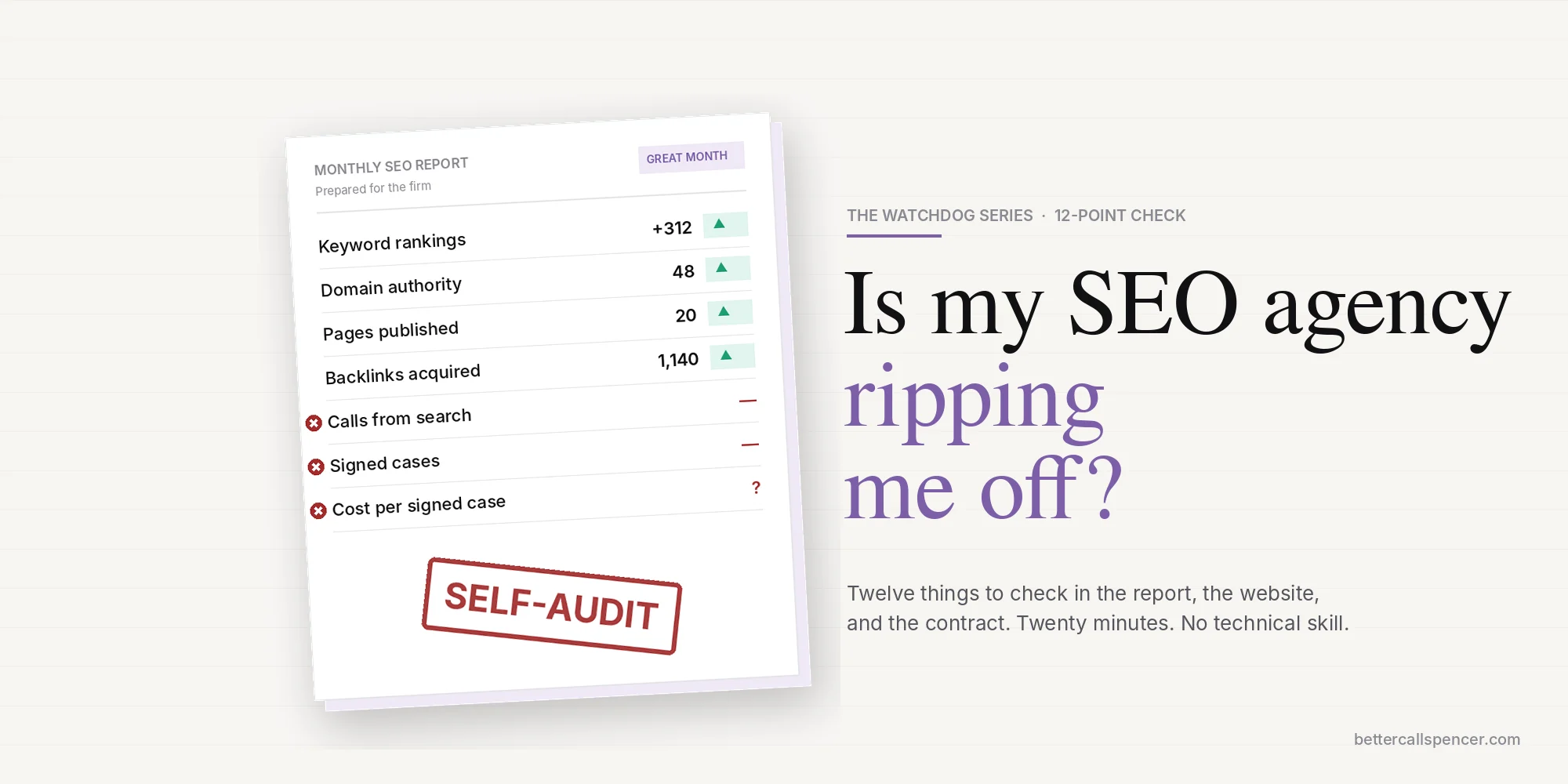
If you are asking this question, something already feels off. A report that got thinner. An invoice line you could not explain to your partners. A “great month” that produced the same number of signed cases as a bad one. You do not need to be a marketer to run this check. You need twenty minutes, your last two agency reports, your Google Search Console login, and your contract.
I spent a decade on the firm side of this relationship, most of it as Director of Digital Marketing at Jim Adler & Associates, and I now audit legal marketing vendors for a living. This is the checklist I run first. Twelve items in three places: the report they send you, the website they manage, and the contract you signed. Score it at the end.
Is my law firm’s SEO agency ripping me off? The short answer
Probably not in the way you fear. Outright fraud is rare. What is common, and what costs firms far more money, is an agency that is paid to produce activity instead of cases: pages nobody reads, rankings for terms nobody searches, reports built to make the agency look busy. The test below does not ask whether your agency is dishonest. It asks whether the work they bill for could plausibly produce a signed case. If most of it could not, the label does not matter.
Before you start
Pull up your last two monthly reports, log into Google Search Console and Google Analytics yourself (not through a screenshot the agency sent), and have the signed contract open. If you cannot log into any of these, write that down. It is finding number one.
Part one: what their report tells you
1. The report leads with rankings, traffic, or “domain authority”
What to look for. Look at the first page of the report. What is the headline number? Keyword rankings, sessions, impressions, backlinks, domain authority, or a score from their own tool?
What it means. Those are activity metrics. None of them is a case. An agency that leads with them either does not know how many cases it produced or does not want you to see the number. The report you want leads with calls, qualified leads, and signed cases, by channel, with cost per signed case. Why the numbers in your report don’t bring in cases.
2. The ranked keywords are not ones a client would type
What to look for. Find the keyword rankings table. Read ten of the terms out loud. Would a person who was hit by a truck yesterday type any of them?
What it means. Agencies pad ranking reports with long, specific phrases that are easy to rank for and that nobody searches: “best personal injury attorney for motorcycle wreck in Spring Branch area.” Ranking #1 for a phrase with zero searches is a decoration. Count how many of the top-ten terms you would actually bid on in Google Ads. If it is fewer than half, the table is for show. Which personal injury searches actually produce cases.
3. Nobody can tell you the cost per signed case, by channel
What to look for. Ask one question by email: “What was our cost per signed case from SEO last quarter, and how did you calculate it?”
What it means. A competent agency has an answer within a day, because they built call tracking and CRM attribution into the engagement. An evasive one says attribution is “complicated,” that SEO is “a long game,” or that they “don’t have access to your case data.” If they have been paid for a year and cannot connect their work to a case, they have been measuring the wrong thing on purpose.
4. The report has not changed in six months
What to look for. Put the last two reports side by side. Are the sections, charts, and recommendations the same, with new numbers dropped in?
What it means. Templated reports mean templated work. A firm whose search landscape changed as much as yours did this year, with AI Overviews rewriting the results page, should see different recommendations every quarter. Identical reports are the clearest sign that nobody senior is looking at your account. What changed in search this year, and why your agency should have mentioned it.
Part two: what your own website tells you
5. The site is filling up with pages about restaurants, hospitals, and “things to do”
What to look for. Go to Search Console, open Pages, and sort by impressions, lowest first. Then browse your own blog or “resources” section for the last six months of posts.
What it means. Content quotas produce filler. “Lakeway & Travis County Restaurants” on a law firm site is not local SEO; it is a page delivered so the invoice can say twenty pages were delivered. Those pages dilute the site’s authority and signal to Google that you are not an injury law firm. The fix is to delete them, not redirect them. Why agencies stuff law firm sites with garbage pages.
6. The agency’s logo in your footer links to a page on your domain
What to look for. Scroll to the bottom of your homepage. Click the agency credit. Note the URL you land on.
What it means. A credit that goes to the agency’s own site is normal. A credit that goes to yourdomain.com/agency-name, a sales page for the agency hosted on your site and linking to their other clients, is your authority being routed to them and their other law firm clients. Have it removed this week. How agencies use your site to boost their own SEO.
7. The impressions-to-clicks gap is growing and nobody has explained it
What to look for. In Search Console, set the date range to the last twelve months and look at the impressions line versus the clicks line.
What it means. If impressions are rising while clicks fall, Google is answering the question in an AI Overview and your page is the source that does not get the visit. That is the single biggest shift in legal search in a decade. If your agency has not raised it, they are not watching your account. What AI Overviews are doing to law firm traffic, and the playbook.
8. You do not own the domain, the site, or the Google Business Profile
What to look for. Check who is the registrant on your domain (a WHOIS lookup takes thirty seconds). Check who is the primary owner of the Google Business Profile. Ask who has the WordPress admin login and the hosting account.
What it means. If any of those belong to the agency, you are a tenant, and the rent is whatever they decide when you try to leave. Firms discover this the week they fire the agency, which is the worst possible time. Ownership of every asset should transfer to the firm today, in writing, regardless of whether you stay. Why the Google Business Profile is the asset you cannot afford to lose.
Part three: what the contract tells you
9. They work for your direct competitors
What to look for. Look at the agency’s own website, their case studies, and their footer credits around the web. Count the personal injury firms in your metro.
What it means. An agency running the same playbook for you and the firm across town is not a strategy, it is a template, and the template gets the same rankings for both of you until one of you pays more. It is a conflict of interest they will describe as “industry expertise.” How law firms get played by agencies serving their competitors.
10. The content and the links are theirs when you leave
What to look for. Find the intellectual property clause. Who owns the articles, the pages, the photography, the backlinks they built?
What it means. Some contracts assign ownership of everything produced to the agency, or to a “network” the agency controls. When you leave, the content comes down and the links are redirected to the next client. Everything produced under your retainer should be yours, including the login to wherever it lives.
11. The auto-renew clause nobody read
What to look for. Find the term and termination section. Note the renewal date, the notice window, and the penalty.
What it means. A twelve-month auto-renew with a sixty-day notice window means that if you decide in month eleven that something is wrong, you are already locked in for another year. Put the notice deadline in your calendar now, whatever you decide about the agency.
12. The pitch is “SEO takes time” but the time never ends
What to look for. Count the months since you started. Then count the months in which the agency said results were six months away.
What it means. SEO does take time: real work on a new site needs six to twelve months to show in cases. But “it takes time” is also the most common way to extend a retainer that is not working. By month eighteen, if signed cases from search have not moved, the strategy is wrong, not early. The five reasons law firm SEO stalls, and the fix for each.
You are not auditing their honesty. You are auditing whether the work they bill for could produce a case. If it could not, the label does not matter.
Scoring your agency
Give yourself one point for each item above where the honest answer was “yes, that’s us.”
- 0 to 2. Normal friction. Every agency relationship has a weak spot or two. Send them this list and ask them to close the gaps in the next report.
- 3 to 5. Have a direct conversation. Ask for cost per signed case, ownership of every asset in writing, and a report rebuilt around cases. Give them one quarter. If the next report looks the same, start the notice clock.
- 6 or more. You are the product. The engagement is structured to produce billable activity, and the firm’s cases are incidental to it. Secure the assets first (domain, GBP, site logins), then exit.
If you scored high and feel foolish
Do not. The reports are designed to be read quickly by a busy partner, and the people who designed them are good at it. Every firm I have audited had smart, experienced partners signing off on those reports. The problem was never intelligence. It was that nobody in the room had run a law firm’s search program from the inside.
What to do with the answer
If you want to run this yourself, the list above is enough, and the linked articles go deeper on each item. If you would rather have someone do it who has sat on your side of the table, the Case Capture Audit is this checklist run properly: every channel, every office, measured against the three or four competitors actually taking your cases, in two weeks, for a flat fee. It ends with a prioritized fix list and a recorded walkthrough, not a proposal. If the audit says your agency is fine, I will tell you that, and you will have paid for the certainty.
And if you have an invoice, a report, or a contract that made you ask this question in the first place, send it to me. The Watchdog series runs on exactly that.
Frequently asked questions
How much should a law firm pay for SEO?
There is no right number, only a right ratio. A personal injury firm in a competitive metro can justify $5,000 to $25,000 a month if the engagement produces signed cases at a cost below what the same cases cost through paid search. The price is wrong when nobody can tell you the cost per signed case, at any budget.
How long should SEO take before I see cases?
For a new or neglected site, six to twelve months to see signed cases move. For a site with history, three to six. If an agency is still saying “it takes time” at month eighteen with no change in cases, the strategy is wrong.
Can I audit my own SEO agency without technical knowledge?
Yes. Every item on this list can be checked by a partner or office manager with Search Console access and the contract. The technical questions (site structure, schema, link quality) come later and only matter if the business questions pass.
What should I do before firing my SEO agency?
Secure the assets first: confirm the firm owns the domain, the hosting, the website login, and the Google Business Profile, and export the content. Read the termination clause and send notice inside the window. Only then end the relationship. Firms that fire first and check later sometimes lose the website.
Is it a conflict of interest for an agency to work with competing law firms?
It is at minimum a conflict you should have been told about. Two firms in the same metro competing for the same searches cannot both get the agency’s best effort, and the templates are usually shared. Ask the question directly and in writing.