

As a law firm, you’ve probably received some version of this email:
“I searched for your [law firm area of specialty] in ChatGPT and your firm didn’t show up – but your competitors did. And now you’re leaving thousands of dollars on the table.”
The same tactic was used before with Google Search. Now the hook is AI.
Different channel. Same playbook. Same manufactured panic.
Before paying someone who promises to “make you show up” in AI search, you need to understand that platforms like ChatGPT operate on fundamentally different models.
The First Misconception: You Can “Rank” in ChatGPT
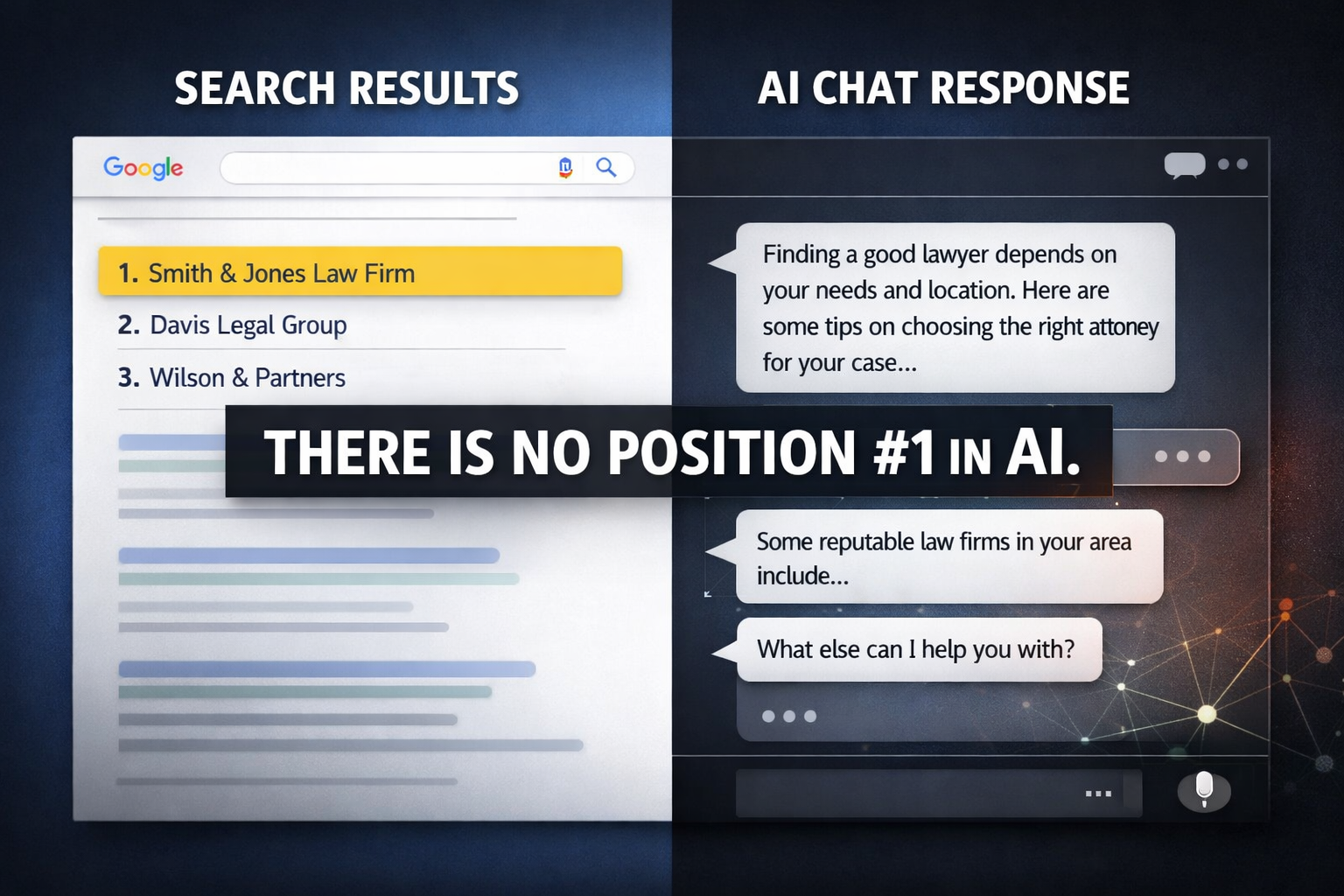
AI search does not work like traditional search engine rankings. It does not produce a fixed, ordered list of websites the way Google Search does.
There is no static “position #1” in AI.
Two users can ask the same question slightly differently and receive different answers. Even the same user may see variations based on context and follow-up prompts.
AI responses are contextual and dynamic, not fixed.
AI systems attempt to interpret intent. If the intent is unclear, responses will be generalized. Often, the system will provide guidance on how to choose a lawyer rather than naming a specific firm. When it does name firms, it may favor those that appear to demonstrate stronger authority signals.
That’s not a ranking issue.
That’s an intent issue.
Generative AI systems synthesize responses based on patterns and trust signals. Outputs are influenced by:
• The specific wording of the query
• Location context
• User intent
• Conversational follow-up
• Patterns of demonstrated authority
These inputs produce probabilistic outputs. Each answer is generated based on language patterns, topic authority signals, and contextual relevance.
Seeing a screenshot of a competitor appearing in a response to one broad query does not establish a stable ranking hierarchy. It demonstrates a single contextual output.
That distinction matters.
So, What Actually Matters to AI?
1. Topical Authority, Not Just Keywords
AI systems tend to surface websites that provide in-depth explanations, legal clarity, demonstrated subject matter expertise, and consistency of focus.
Depth is more extractable than slogans.
Clarity is more stable than volume.
A firm with 30 thin pages targeting variations of a keyword may appear optimized for traditional SEO, but AI systems are more likely to rely on substantive explanations of legal principles, detailed analysis of liability standards, breakdowns of applicable laws such as comparative fault, and step-by-step explanations of legal processes.
AI favors authoritative, substantive content that demonstrates expertise.
Keywords still matter semantically, but they do not function as fixed ranking triggers.
2. EEAT Signals Matter More in Legal
Legal falls into the YMYL category. These are high-stakes decisions involving health, finances, and legal rights. AI systems are designed to be cautious in these domains.
They are more sensitive to misleading claims, guarantees of outcomes, unverifiable superiority statements, thin content, and purely promotional language.
The louder the marketing tone and the thinner the substance, the weaker the authority signal.
Experience must be demonstrated, not implied.
That means strong EEAT signals such as:
• Attorney bios with verifiable credentials
• Trial experience
• Board certification where applicable
• Detailed case results with context
• Transparent fee explanations
• Clear jurisdiction focus
• Consistent messaging across platforms
• Third-party reviews and recognitions
You cannot sustainably “hack” EEAT. It has to be demonstrated through consistent signals.
3. Clarity of Positioning
The real risk isn’t “not showing up.” It’s being generic.
One of the most overlooked factors in AI visibility is clarity of positioning. AI systems perform better when a firm is explicit about what it handles, what it does not handle, who it serves, and where it practices.
Specificity builds authority. Generality dilutes it.
Firms that attempt to cover every topic without focus send ambiguous signals to both clients and AI systems.
AI responses vary depending on:
• Geographic context
• Query specificity
• Legal complexity
• Conversational follow-up
The uncomfortable truth is that many law firm websites look interchangeable. Same slogans. Same stock imagery. Same broad practice lists. Same shallow content.
AI does not reward sameness.
If your positioning lacks depth and clarity, there is no clear signal to elevate you in an AI-generated response.
That’s not a ChatGPT problem.
That’s a positioning problem.
4. Trust and Risk Sensitivity
Trust signals are critical, especially when decisions involve financial or medical consequences. AI systems tend to surface information that appears reliable, authoritative, and verifiable.
Without trust signals, AI cannot distinguish between someone optimized for keywords and someone demonstrating legitimate expertise.
Confidence increases when it sees:
• Recognized expertise through case results, peer reviews, certifications, and bar memberships
• Positive third-party reviews and media mentions
• Transparent explanations of fees and processes
• Consistency across platforms
• Information that can be corroborated
Inconsistency weakens confidence.
Trust is built through transparency, not hyperbole.
Improving AI Visibility Without Falling for the Hype
Improving your likelihood of being referenced in an AI response is not about technical manipulation. It is not a shortcut.
It is about substantive clarity.
Make your content teach.
Make it extractable.
Build depth around your strongest case types.
Demonstrate experience instead of asserting it.
Be precise about jurisdictional rules and local legal processes.
Maintain consistency across your website, directories, and public profiles.
Teach clearly.
Show real experience.
Communicate precisely.
That is how AI systems recognize authority.
Credibility Wins in AI
The real question isn’t: “How do I rank in AI?”
It’s: “How do I become the most credible answer?”
Guarantees of placement misunderstand how generative AI works. These systems produce contextual outputs, not fixed rankings.
What endures:
• Clear specialization
• Demonstrated litigation experience
• Jurisdiction-specific depth
• Transparent client processes
• Ethical marketing
• Consistent identity across platforms
AI does not reward noise. It does not rely on short-term tactics.
It tends to elevate defensible authority built on clarity, legal accuracy, demonstrated experience, and trustworthiness.
That is the foundation of client trust.
Platforms will evolve.
Credibility will not.