


Your impressions are up. Your clicks are down. Your rankings have not moved. If that describes your firm’s Search Console report for the last year, nothing is broken. Google is answering the question itself, at the top of the page, often using your content to do it, and the person never visits.
This is the practical guide to AI Overviews for law firms: what they are, what Google’s AI Mode adds, who gets hit hardest, and the specific moves that turn an impression you no longer get a click for into a case you still sign.
What are Google AI Overviews?
AI Overviews are Google’s AI-generated summaries that appear above the ads and above the organic results for a growing share of searches. They pull from pages across the web, cite a handful of sources, and answer the question in place. Think of ChatGPT bolted onto the top of the results page.
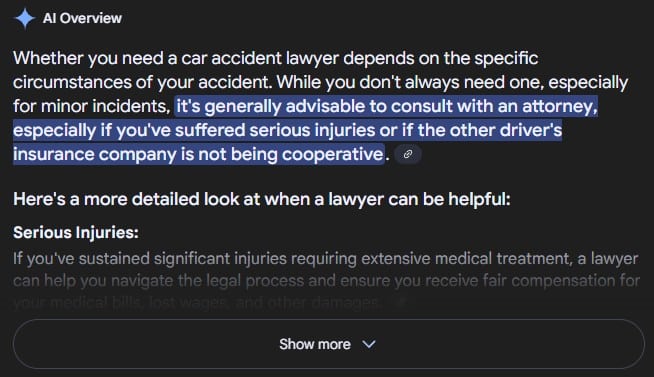
Three things follow from that for a law firm:
- Your content can be referenced without your link being clicked.
- Someone can get an answer to a legal question without ever seeing your firm’s name.
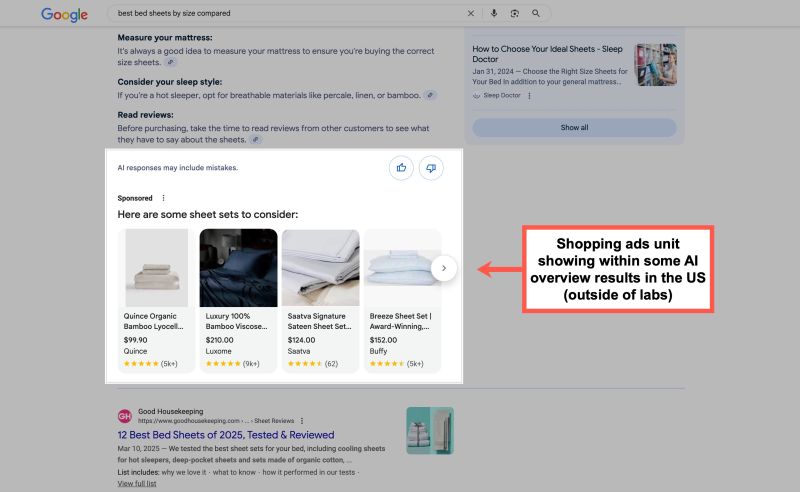
- Google is now placing ads inside the summary itself, which means a competitor can appear inside the “answer” to a question your page helped write.
What is Google AI Mode, and how is it different?
AI Mode is the next step: a separate tab in Google Search where the whole results page is a conversation. You ask a question, Google answers in full, you ask a follow-up, and links appear as supporting citations rather than as a ranked list. Where AI Overviews sit on top of the traditional results, AI Mode replaces them.
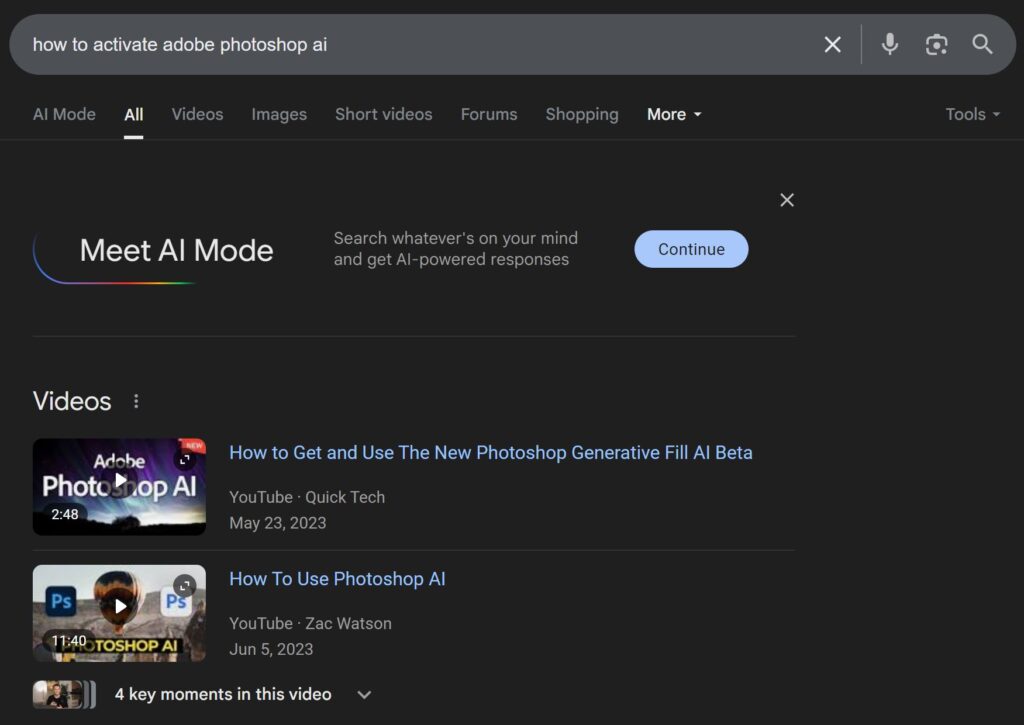
For law firms the implication is the same, only more so. In AI Mode there is no “position three.” There is cited or not cited. The signals that get you cited are the same ones that get you into an AI Overview, so everything below applies to both.
Why is law firm traffic dropping even when rankings are stable?
Because the click is being intercepted, not the ranking. Here is what it looks like in a real personal injury firm’s Search Console the month AI Overviews rolled out broadly:
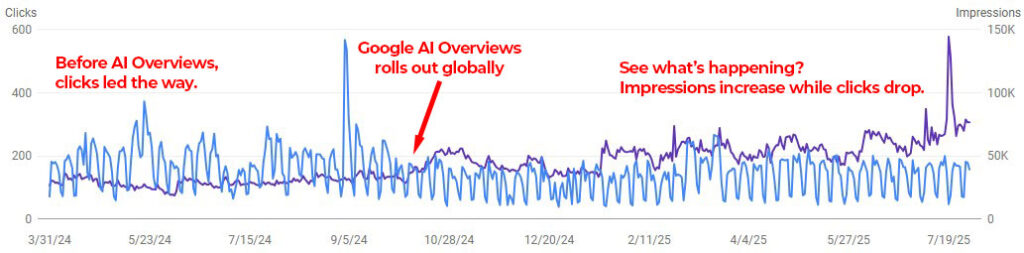
The pattern is consistent: impressions hold or rise, CTR falls, and the drop concentrates in question-style queries. “Can I sue if I slipped in a store?” “What should I do after a car accident in Texas?” “Is it illegal for an insurer to delay a claim?” Those are exactly the searches Google feels confident answering for you.
Who gets hit hardest
Personal injury, immigration, estate planning, family law: any high-volume practice area in a “Your Money or Your Life” category where the first question is informational. If your library is built on answering those questions, and most law firm blogs are, you are in the blast radius.
The part most firms miss
An impression without a click is still a touchpoint. Your page helped Google answer the question. The firm that gets named in the summary is building recall it did not have to pay for. The strategy is to make sure that firm is you, and then to catch the person when the question turns into “who do I call.”
What does Google reward in AI Overviews?
You do not need to understand the model. You need to understand what it is looking for, and it is not new.
- Topic ownership, not keyword targeting. A car accident lawyer does not need one page; it needs a hub page plus the sub-topics around it: rear-end collisions, T-bone crashes, rideshare accidents, common injuries, settlement timelines, fault disputes. Build the cluster and link it together so the model can see you cover the whole subject.
- Information gain. Content that repeats what every other firm says gets filtered. Content that adds something gets cited: a case example, a plain-English explanation, the deadline nobody mentions, what actually happens when the adjuster calls. This is the whole content strategy now.
- Structure the model can lift from. Headings that state the question. The answer in the first two sentences. FAQs as real FAQs. LegalService, Attorney, and FAQPage schema that matches what the page says.
- Real people with real credentials. Author bylines, attorney bios with years in practice and notable results, and consistency between the site, the bar listing, and the Google Business Profile. E-E-A-T is how a machine decides you are a source and not a content farm.
The playbook: how law firms adapt to AI Overviews
Five moves, in order. The first two are about search. The last three are about capturing the person you no longer get the first click from.
1. Find your high-impression, low-click queries
In Search Console, filter the last three months for queries with impressions up and CTR down, then look for anything starting with “can I,” “should I,” “how do I,” “what happens if.” That list is where AI Overviews are answering with your content. It is also your map of what the market is asking.
2. Shift weight toward queries AI cannot close
AI can summarize a statute. It cannot take a case. Prioritize the searches that need a person: “best Uber accident lawyer in Houston,” “Spanish-speaking injury lawyer free consultation,” “car accident attorney near me open now.” Rework your practice-area and location pages for those, keep the informational pages as the citation layer, and make sure the Google Business Profile is in order, because the map pack is where the hiring query actually lands.
3. Treat the impression as an audience
If someone does reach the site and leaves, do not lose them. Microsoft Clarity or Tag Manager will tell you what they read and how far they got. Build retargeting audiences from that in Meta, YouTube, and the Google Display Network, and match the creative to the topic: the person who read about rear-end accidents sees a client who won a rear-end case.
4. Give the research-stage visitor a reason to raise their hand
Lead magnets are underused in legal marketing and they work when the brand is credible. “What to do after an Uber or Lyft crash in Houston.” “Ten mistakes that can ruin a personal injury claim.” Distribute through Meta lead ads, gate with name and email only, and tag those contacts as top-of-funnel. The impression becomes a name.
5. Close the loop with search remarketing
Two days after reading your rideshare article, that same person searches “best Uber accident lawyer near me.” With RLSA audiences in Google Ads you can bid higher for that search, show a stronger call to action, and send them to a page built to convert. Personal injury is the ideal case for this: the journey starts with research and ends in urgency, and you want to be the last name they saw before the urgent part.
AI can summarize a statute. It cannot take a case. Build for the moment the question turns into “who do I call.”
How do you track whether your firm appears in AI search?
Rank trackers do not see it. Once a month, run your twenty most important practice-area and location questions through Google (with AI Overviews), AI Mode, ChatGPT with browsing, Perplexity, and Copilot. Log who is cited for each, whether the citation is accurate, and what changed since last month. Then work the gaps. That monitoring routine is the one genuinely new deliverable in all of this; everything else is SEO with a different scoreboard. If you would rather not build the routine yourself, it is the core of AI Search Optimization.
What should a law firm do this quarter?
- Pull the high-impression, low-click query list from Search Console.
- Pick one practice area and build out its topic cluster properly: hub, sub-topics, internal links, FAQ schema.
- Rewrite the top five informational pages so the answer is in the first two sentences and the firm’s experience is in the body.
- Fix bylines, bios, and the Google Business Profile so the same facts appear everywhere.
- Set up retargeting audiences and one lead magnet for the highest-impression topic.
- Start the monthly citation check and keep the log.
SEO for law firms is not dead. The version of it built on individual keywords and a 900-word post every Tuesday is. The firms that adapt now, by owning topics, by being a named source, and by building the system that catches the person after the summary, will be the ones the next phase of search sends cases to. If you want to know where you stand today, the audit includes an AI visibility read on every practice area you care about, and the first call is twenty minutes.