

Pay-per-lead legal directories are worth it for some firms and a money pit for others, and the difference is almost never the directory. It is whether you verified what you were buying before you bought it. Martindale-Nolo, Martindale-Avvo, LegalMatch, and the rest sell the same thing in different packaging: a consumer who filled out a form, delivered to one or more lawyers for a fee. The public reviews of these services, read carefully, tell you exactly which questions to ask before you sign.
I spent a decade on the firm side of this relationship, most of it as Director of Digital Marketing at Jim Adler & Associates, and I now audit legal marketing vendors for a living. Directory contracts cross a marketing director’s desk every quarter, and most of them are signed on a sales call rather than on the math. This is the Watchdog guide I wish someone had handed me first. It covers who owns what, what the reviews actually say, the ethics rule that governs all of it, and the eleven questions to settle before any money moves.
A note on sourcing
Every complaint summarized below comes from public reviews on Trustpilot, read in October 2026, or from the companies’ own published materials. Reviews are opinions of the people who wrote them, not findings. I link to the source pages so you can read them yourself and draw your own conclusions. Review counts and ratings change daily.
First, who owns what
This matters more than it used to. In December 2024, Thomson Reuters completed the sale of FindLaw to Internet Brands (see the Thomson Reuters press release). Internet Brands already owned Martindale-Hubbell, Avvo, Nolo, and Lawyers.com. That means FindLaw websites, Martindale-Nolo leads, Martindale-Avvo profiles, and Avvo advertising are now products of a single parent company.
For a firm, the practical consequence is simple. If you have a FindLaw site, a Martindale-Nolo lead subscription, and a sponsored Avvo profile, you do not have three vendors. You have one vendor with three invoices, and your negotiating leverage is shared across all of them. It also means a cancellation problem with one product can shape how you are treated on the others, because the account relationship is the same.
If you are already weighing whether to leave the website side of that relationship, I wrote a separate guide on switching away from FindLaw. This article is about the lead-generation side.
How pay-per-lead directories actually work
The mechanics are worth spelling out because the sales pitch usually skips them. A directory runs consumer-facing content and ads, often ranking for questions like “how much is my car accident case worth.” A visitor fills out a form describing their problem. The directory matches the form to lawyers who have bought that practice area and geography, then sends the lead by email, text, or dashboard. You pay per lead, per month, or per block of impressions depending on the product.
Three details decide whether that lead has value:
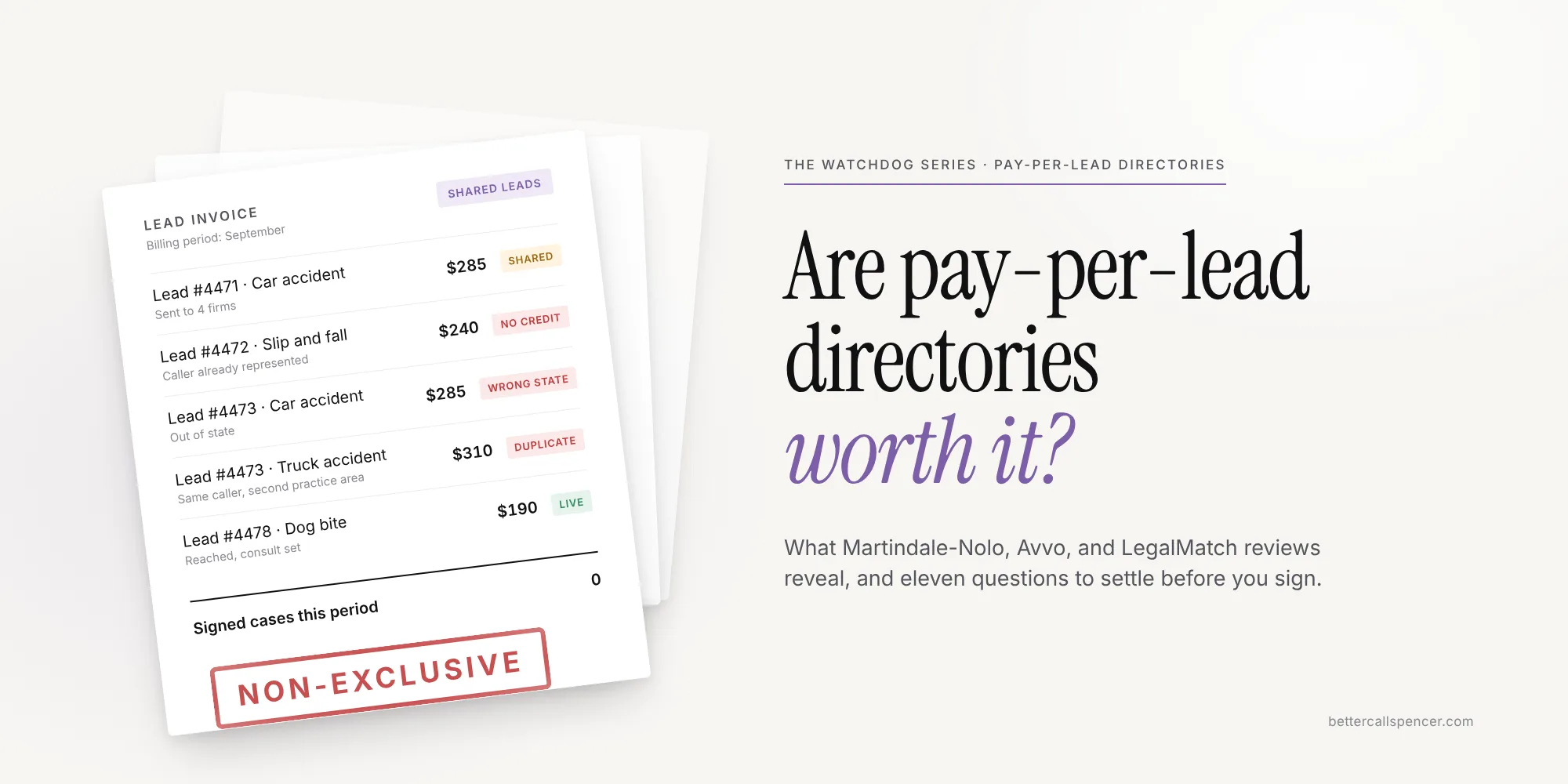
- Exclusivity. Is the lead sent to you alone, or to several lawyers at once? A lead sent to four firms is a race, and the firm that calls within seconds usually wins.
- Qualification. Did a person screen the lead, or did a form field? Form-only leads include people outside your state, people with no injury, and people who already have a lawyer.
- Credit policy. When a lead is bad, what happens? Who decides, how fast, and is the decision final?
Every complaint pattern in the reviews below traces back to one of those three.
What the Martindale-Nolo reviews say
Nolo’s lawyer-facing lead product is marketed as Martindale-Nolo. The Nolo for Lawyers on Trustpilot page shows a 1.8 out of 5 rating across roughly 130 reviews as of October 2026, with about two-thirds at one star. Read the page carefully before quoting it, because the reviews are a mix of consumers who used Nolo’s self-help products and attorneys who bought leads. Both groups matter, but only the attorney reviews speak to the lead product.
Among the attorney reviews, five complaints repeat often enough to count as patterns rather than one-off grievances:
- Leads that reviewers describe as fabricated or unreachable. Phone numbers that do not connect, names that do not match the number, or consumers who say they never filled out a form.
- Credit requests refused. Reviewers describe asking for credit on leads outside their state or practice area and being told the lead met the contract definition.
- Non-exclusive distribution. Reviewers report reaching the consumer only to learn several other lawyers had already called.
- Out-of-area matching. Leads from states where the attorney is not licensed, which are useless to the firm and not always credited.
- Templated responses. The company replies to negative reviews on Trustpilot, but reviewers note the replies read as the same message each time rather than a resolution.
To be fair to the company, replying to every negative review is more than most vendors do, and the contract language reviewers quote is usually consistent with what they signed. That is the point. The contract defines a billable lead, and the definition is wider than most lawyers assume.
What the Martindale-Avvo reviews say
The Martindale-Avvo on Trustpilot page tells a different story on the surface. It shows a 4.4 out of 5 rating across about 80 reviews as of October 2026. But roughly a quarter of those reviews are one star, and nearly all of the one-star reviews are from attorneys. The high average comes from a cluster of positive reviews about onboarding representatives, which is not the same thing as positive reviews about lead quality.
The attorney complaints that appear in late 2026 reviews are specific enough to be useful:
- A September 2026 reviewer describes a single lead being billed under two practice areas, producing two charges for one consumer.
- Another September 2026 reviewer describes submitting a cancellation and continuing to be billed while the request went unanswered.
- Several reviewers describe onboarding that took more than a month before any lead arrived, while billing began at signature.
None of these are unusual in the industry. They are unusual in how clearly they show where to look in the contract: the billing definition of a lead, the cancellation mechanics, and when the billing clock starts relative to when delivery starts.
Avvo advertising is a different product, and the reviews conflate them
Avvo’s own paid products, listed on Avvo for Lawyers, are not pay-per-lead. Avvo Pro runs around $49 per month and mostly removes competitor ads from your profile. Avvo Advertising sells blocks of impressions starting around $100 per month, meaning you pay for visibility in a geography and practice area, not for an individual consumer. Reviewers often blend Avvo advertising with Martindale-Nolo leads because the same account representative may sell both. They are different purchases with different measurement problems.
With impression-based advertising, the question is not “was this lead bad” but “can I tell whether any case came from this at all.” Avvo profiles do not pass a usable referral source through to your intake system unless you build it yourself. If your intake form does not ask “how did you find us” and record the answer, you will never be able to answer that question, and the renewal conversation will be about faith rather than data.
LegalMatch, for context
LegalMatch is not an Internet Brands company, but it is the comparison most lawyers reach for, so it belongs here. The LegalMatch on Trustpilot page shows a 3.4 out of 5 rating across more than 2,700 reviews as of October 2026. Most are consumers. The attorney reviews cluster around three complaints: weak leads, subscriptions reviewers describe at around $600 per month, and multi-year contracts the company would not let them buy out early.
That last one is the pattern to notice across every service in this article. The product is sold as a monthly cost. The commitment is usually annual or longer. Ask which one you are signing.
A lead vendor is not lying to you when it bills for a lead you consider worthless. It is billing for what the contract defines as a lead. Your job is to narrow that definition before you sign, not to argue it afterward.
The ethics rule that governs all of this
Paying for leads is permitted in most states, within limits, and those limits are the best negotiating tool you have. ABA Model Rule 7.2 prohibits paying anyone for recommending your services. The comment to ABA Model Rule 7.2 explains how lead generation fits: a lawyer may pay for leads from a service that is not a recommendation, as long as the service does not pay the lawyer based on outcomes, does not imply it has vetted or endorsed the lawyer, and does not use a selection process that amounts to a recommendation. The lawyer remains responsible for the vendor’s conduct toward the consumer.
State versions vary. Washington, for example, treats a vendor’s subjective selection of which lawyer gets a lead as a recommendation, which makes some matching products a problem there. Several states have older opinions on pay-per-service arrangements that are still cited. Check your own state’s rule and any lead-generation opinions from your bar before signing.
Why this helps you at the table: the rule gives you a legitimate reason to demand the vendor’s consumer-facing language, its matching logic, and its fee structure in writing. A vendor that will not show you how it presents your firm to the consumer is asking you to take a compliance risk you cannot assess.
Eleven questions to settle before any money moves
Get written answers. If the representative answers verbally and the contract says something different, the contract wins.
On the lead itself
- Is the lead exclusive? If not, how many firms receive it, and are you told that number per lead?
- What is the contract definition of a billable lead? Ask for the clause, not the summary.
- Is there any human screening before delivery? If a form is the only filter, assume one in three leads is unusable and price accordingly.
- How is geography enforced? By the consumer’s stated location, their IP address, or the incident location? Each produces a different error rate.
On credits and billing
- What qualifies for a credit, who decides, and within how many days? Wrong state, wrong practice area, existing representation, duplicate, and unreachable should all be listed.
- Can one consumer generate two charges? Ask directly whether a lead can be billed under two practice areas.
- When does billing start? At signature, at onboarding completion, or at first lead delivered? If onboarding takes a month, that month should not be billed.
- Is there a monthly cap, and can you pause? A cap protects you from a $4,000 month you did not plan for.
On the relationship
- What is the commitment term and the cancellation mechanism? Get the notice period, the method (email, portal, certified mail), and the confirmation you will receive.
- How is the firm presented to the consumer? Request screenshots of every page and message the consumer sees that mentions your firm.
- Can you attribute signed cases to the service? If the lead arrives without a unique identifier you can carry through intake to signature, you cannot measure return, and you should not renew on a representative’s summary.
How to measure whether it is working
Measure cost per signed case, not cost per lead. A $75 lead with a 2 percent sign rate costs $3,750 per case. A $300 exclusive lead with a 15 percent sign rate costs $2,000 per case. The cheaper lead is the expensive one. Most firms never run this math because the lead cost is visible on the invoice and the sign rate is buried in intake.
The fix is operational, not analytical. Tag every directory lead with its source and lead ID at intake. Record the outcome of every contact attempt. Review the list monthly against the invoice, and file credit requests inside the window on every lead that qualifies. The firms that make directories work are the ones that treat the credit window as a deadline, not a suggestion.
If you already signed and the numbers are bad
Do three things in order. First, pull every lead from the last ninety days and classify it: reachable, unreachable, wrong area, duplicate, already represented. Second, file credits on everything that qualifies under the contract, in writing, inside the window. Third, send the cancellation notice by the contract’s required method now, even if the term runs for months, so the clock starts. Do not wait for a conversation with a representative to do any of these.
Where directories fit, and where they do not
Directory leads can make sense for a firm that is new to a market, has intake staffed to answer within a minute, and treats the spend as a short-term bridge while search visibility is built. They rarely make sense as a permanent line item, because you are renting demand that your own site could own. Every dollar spent on a lead that belongs to a directory is a dollar not spent on content, reviews, and local presence that produce leads you do not have to share or credit.
If you are not sure which of your current vendors is producing signed cases, start with the self-audit and the red-flags checklist, then decide whether the directory spend survives the comparison.
Frequently asked questions
Is it ethical to buy leads from Martindale-Nolo or Avvo?
In most states, yes, within the limits of your state’s version of Rule 7.2. The vendor cannot be paid based on case outcomes, cannot imply it recommends or vetted you, and cannot use a selection process that amounts to a recommendation. You remain responsible for how the vendor presents your firm. Check your state bar’s lead-generation opinions before signing.
Are Martindale-Nolo leads exclusive?
Reviewers consistently describe them as non-exclusive, meaning the same consumer is sent to more than one lawyer. Ask the representative for the contract clause that states how many firms receive each lead, and get it in writing.
How much do pay-per-lead legal directories cost?
It varies by practice area and market. Personal injury leads are among the most expensive. Avvo’s advertising products are impression-based and start around $100 per month. LegalMatch reviewers describe subscriptions around $600 per month. Martindale-Nolo pricing is per lead and quoted by market. The number that matters is cost per signed case, which only your intake data can tell you.
Does FindLaw own Martindale-Nolo and Avvo?
No. All of them are owned by Internet Brands, which bought FindLaw from Thomson Reuters in December 2024 and already owned Martindale-Hubbell, Avvo, Nolo, and Lawyers.com. If you buy more than one of these products, you have one vendor with several invoices.
Can I get a refund for bad leads?
Usually a credit against future leads rather than a refund, and only for categories the contract lists, requested within a set window. Read the credit clause before signing and file every qualifying request on time.
What is a good conversion rate for directory leads?
There is no reliable public benchmark, and vendors rarely publish one. Shared, form-only leads tend to convert far worse than exclusive, screened leads, which is why the two should never be compared on price per lead. Track your own rate monthly and compare cost per signed case across every source you pay for.